Archery Handicap and Classification Systems Explained

You've learned how scoring works, shot a few rounds, and written down a total. Then someone at the club asks, "What's your handicap?" or mentions they just got their Bowman classification, and you realize the numbers on your scorecard are only half the story.
Handicaps and classifications are how archery answers a question the raw score can't: how good is that score, really? A 540 on one round isn't comparable to a 540 on a different round, at a different distance, with a different bow. These systems fix that.
This guide explains what handicaps and classifications are, how they work, and how the systems differ between the UK and the US.
(New to scoring? Start with Archery Scoring Explained. This post builds on it.)
The Problem These Systems Solve
Raw scores have two big limitations:
- They only make sense within one round. A perfect score on an 18-meter indoor round is 600, while the outdoor 70-meter round tops out at 720. A "good" score on one tells you nothing about the other.
- They don't let different archers compete fairly. A beginner with a 400 and an experienced archer with a 580 can't meaningfully compare themselves, even if the beginner just had a personal best.
A handicap gives each archer a number that follows them from round to round, and a classification gives them a named level to aim for. Together, they let you track real progress and compare scores across different rounds.
What Is an Archery Handicap?
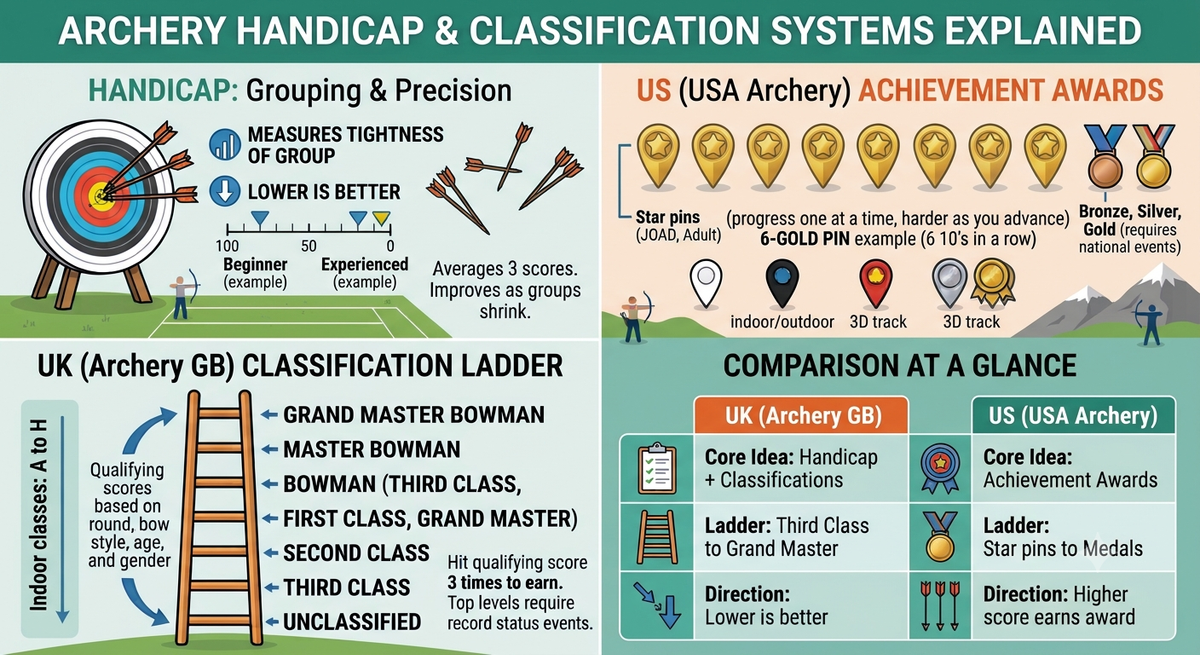
An archery handicap is a number that measures how precisely you shoot, specifically, how tightly your arrows group. It's worth knowing one rule right away, because it surprises beginners:
A lower handicap is better.
According to Archery GB, "the smaller the handicap, the smaller the group and the better the score." Handicaps typically run on a scale from 0 to 100. A beginner might sit in the higher range, and as you improve, your number drops.
The reason it works across rounds is that official handicap tables list the handicap that corresponds to each score on each round. Look up your score for the round you shot, and the table tells you what handicap that performance equals. A score of 540 on one round and a score of 600 on another might represent the exact same handicap, which means the same level of precision.
How Your Handicap Is Calculated
The basic process, as described by Archery GB:
- Shoot your first three scores. Look up the handicap each score equals, then average the three. That becomes your starting handicap.
- Improve it as you shoot better. When you shoot a score that works out to a lower handicap than your current one, your handicap is recalculated and improves. Worse scores don't count against you, so a bad day or bad weather won't push your number back up.
- Reset each season. At the end of each season, your three best handicaps are averaged to set your starting handicap for the next one. Outdoor handicaps are generally reassessed at the start of the calendar year and indoor handicaps around mid-year, but check your own club's records officer for exact dates.
An illustrative example (the numbers here are made up to show the method, not taken from the official tables): Say you shoot three indoor rounds, and the tables convert them to handicaps of 52, 48, and 50. Averaged, your starting handicap is 50. A month later, you shoot a round that converts to a handicap of 44. Your handicap improves, and your next target becomes beating that number.
What a Handicap Is Also Used For
Beyond tracking progress, handicaps make it possible to run handicap competitions, where archers of very different skill levels compete on equal footing. The handicap evens out the field, so a newer archer who shoots well for their level can beat a more experienced one who has an average day. It's a big part of why club shoots stay fun for beginners.
What Are Archery Classifications?
If a handicap is a continuous number, a classification is a named level, like a belt rank in martial arts. Each classification corresponds to a specific handicap, which means a specific score on each round. Hit the qualifying score enough times, and you earn the classification.
Archery GB Outdoor Classifications
In the UK, the outdoor classifications from lowest to highest are:
- Unclassified
- Third Class
- Second Class
- First Class
- Bowman (Junior Bowman for younger archers)
- Master Bowman
- Grand Master Bowman
Indoor Classifications
Indoor classifications use a different scheme: letters, from A to H. The qualifying scores for each depend on the round and your bow style, so check the official tables or your club's records officer for the exact thresholds.
How You Earn a Classification
A few rules apply to most Archery GB classifications:
- You need three qualifying scores at the required level for each classification, not just one lucky round.
- The lower levels can be earned at ordinary events. Third Class, Second Class, First Class, and Bowman can generally be earned at club shoots and competitions.
- The top levels are stricter. Master Bowman and Grand Master Bowman require scores shot at record status events, which are officially sanctioned tournaments, and submitted to Archery GB.
- Classifications are reassessed each year. Your classification reflects your recent shooting, so you keep it by continuing to shoot at that level.
Qualifying scores are specific to your bow style (recurve, compound, barebow, and so on), your age group, and your gender category where applicable, so the number you need to hit for a classification depends on those factors.
The US Approach: Achievement Awards
The US takes a somewhat different path. Instead of one handicap number and a ladder of named classes, USA Archery runs Achievement Awards programs, with separate tracks for adults, juniors (JOAD), and 3D archery.
- Star pins. Archers earn colored star pins by hitting target scores on specific rounds, indoors or outdoors, progressing through pins one at a time and in order. The pins get harder as you advance.
- The 6-Gold pin. A fun one: you earn it by shooting six 10s in a row, either in one 6-arrow end or across two consecutive 3-arrow ends.
- Bronze, Silver, and Gold awards. These are earned by shooting a specified distance and target face at national events.
Scores required depend on your bow style, distance, and target face. For example, an adult compound archer working toward a red star outdoors at 50 meters needs a total in the 300s on a standard outdoor round. Other US organizations, such as the NFAA, run their own class systems for their own formats, so what applies to you depends on which events you shoot.
UK vs. US at a Glance
| UK (Archery GB) | US (USA Archery) | |
|---|---|---|
| Core idea | A handicap number, plus named classifications | Achievement awards: pins and medals |
| Direction | Lower handicap is better | Higher score earns a higher award |
| Ladder | Third Class up to Grand Master Bowman (outdoor), A to H (indoor) | Star pins up through Bronze, Silver, Gold |
| Works across rounds? | Yes, through handicap tables | Thresholds are set per round and bow style |
| Highest levels | Require record status events | Several awards require national events |
Which System Should You Use?
- If you shoot with a UK club, your records officer will track handicaps and classifications for you. Ask which rounds count and how to submit scores.
- If you shoot with a US club, ask your club leader about the Achievement Awards. Many clubs hand out pins as a built-in way to give new archers a goal.
- If you just shoot for fun, you can still calculate your own handicap. It's a free way to see your real progress, even if nobody's keeping official records.
Why It's Worth Caring About as a Beginner
- It turns "I got a 340" into "I'm improving." A handicap that drops over a few months is far more motivating than a raw total that changes with the round you picked.
- It gives you a goal that's always one step away. Third Class, then Second, then First is a clear ladder, and the first rungs are reachable within your first year of regular shooting.
- It makes club life better. Handicap competitions mean you're competing with your peers, not just against the strongest archer at the range.
The Takeaway
A handicap tells you how precisely you shoot, with lower being better, and it lets you compare scores across different rounds. A classification gives you a named level to chase, and the US equivalent is the achievement awards. Both exist so that your improvement is visible even when the rounds, bows, and conditions change.
If you'd rather skip the table lookups, you can use ScoreMyArrow's handicap and classification calculator to find your handicap and see how close you are to your next classification.
Tables and qualifying scores are updated from time to time, so use the current official versions from Archery GB or USA Archery for anything official.
Sources