The Barebow Renaissance: How to Get Started Without the Complex Gear

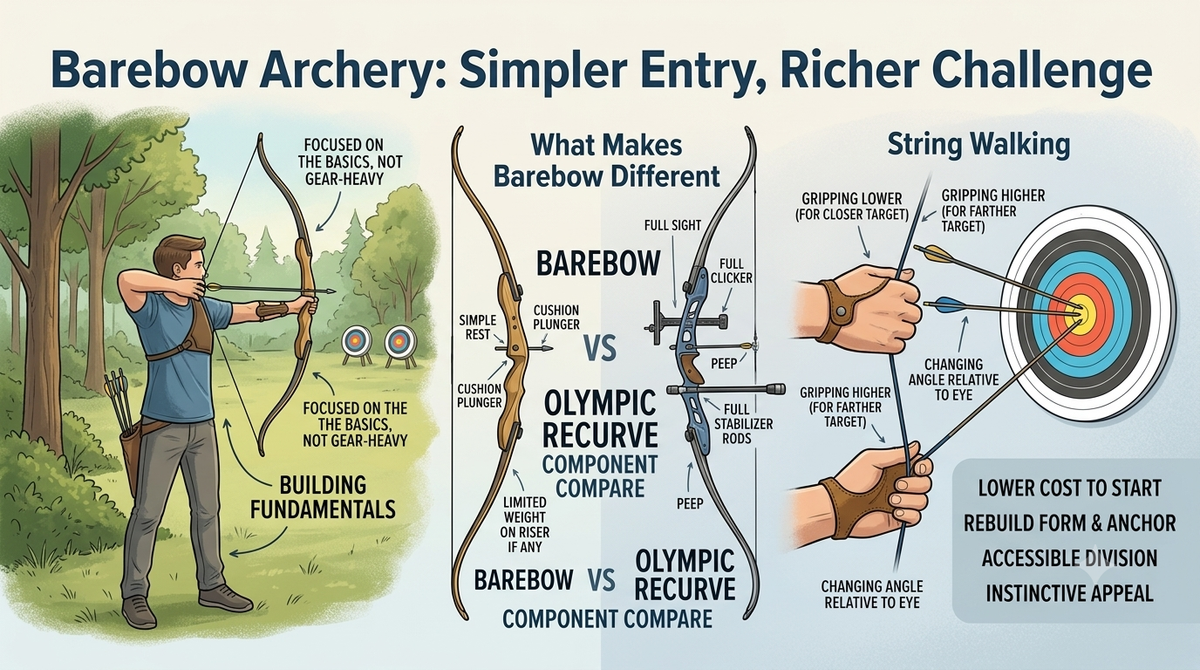
Walk around most archery ranges today and you'll notice something: more bows stripped down to the basics, no sight, no stabilizer, no clicker, just a riser, limbs, a string, and an archer figuring out distance by feel. Barebow archery, once considered a stepping stone discipline, has quietly become one of the fastest-growing corners of the sport, drawing beginners who find the gear-heavy side of archery intimidating and experienced archers looking to rebuild their fundamentals.
If you've been eyeing barebow as a simpler entry point, here's how it actually compares to the gear-heavier styles, and a practical starting guide for riser choice, rest and plunger setup, and the aiming method that replaces a sight entirely: string walking.
(New to archery altogether? Start with our guides to recurve vs. compound and stance and form first, barebow builds directly on recurve fundamentals.)
What Makes Barebow Different
"Barebow" describes a recurve bow shot without a sight, stabilizers, or a clicker, the equipment restrictions are actually defined by World Archery's competition rules, not just a personal style choice. A barebow setup is typically allowed:
- A riser and limbs (standard recurve equipment)
- A rest and plunger (cushion plunger) for arrow clearance
- A single stabilizer point, within strict weight and length limits, if used at all
- Weights on the riser, within limits
- A string, with no peep sight, no sight marks, and no draw check devices like a clicker
What's missing compared to Olympic recurve is the thing most beginners assume is essential: the sight. Without it, aiming becomes instinctive, or more precisely, a learned skill based on reference points on the bow itself, called string walking or gap shooting (more on that below).
Barebow vs. Compound vs. Olympic Recurve
| Factor | Barebow | Olympic Recurve | Compound |
|---|---|---|---|
| Sight | None | Yes | Yes |
| Stabilizer | Single, limited | Full stabilizer system | Full stabilizer system |
| Aiming method | String walking / gap shooting | Sight pin | Sight pin + peep |
| Draw check (clicker) | Not allowed | Yes, standard | Mechanical let-off serves a similar role |
| Equipment cost to start | Lower, fewer accessories needed | Higher | Highest |
| Learning curve | Steep for aiming, simpler mechanically | Moderate | Gentler for early accuracy |
| Setup complexity | Minimal | Significant tuning | Most components to tune |
The appeal for beginners is straightforward: fewer parts means fewer things to buy, fewer things to tune, and fewer things that can go wrong. The tradeoff is that the skill moves from the equipment to the archer, aiming without a sight takes real practice to get consistent.
Why It's Having a Moment
A few things are feeding the renewed interest in barebow specifically:
- Lower upfront cost. Skipping a sight, full stabilizer setup, and clicker meaningfully reduces the price of getting started.
- A return to fundamentals. Archers coming from Olympic recurve or compound often pick up barebow specifically to rebuild form that got masked by equipment, you can't rely on a sight to paper over inconsistent anchor points or shot execution.
- Growing competition presence. Barebow divisions have expanded at World Archery and national-level events, giving the discipline a competitive pathway that didn't always exist.
- The instinctive-shooting appeal. For archers drawn to a more traditional, feel-based style without going fully to primitive or traditional equipment, barebow sits in a comfortable middle ground.
Step 1: Choosing a Riser
Your riser is the foundation of a barebow setup, and a few things matter more here than they do for a sighted setup:
- Weight. Barebow risers tend to run heavier than Olympic recurve risers, since without a full stabilizer system, the riser's own mass helps dampen vibration and stabilize your hold. Many dedicated barebow risers are built with this in mind.
- Length. A 23–25 inch riser paired with appropriate limbs is a common beginner combination, but riser length interacts with your draw length and limb choice, so it's worth getting fitted rather than guessing.
- Grip shape. Because your bow hand placement is part of your aiming reference in barebow (more on string walking below), a grip that lets you find the exact same hand position every time matters even more than in sighted disciplines. Try a few in person if you can.
- Budget option first. A mid-range aluminum riser is a sensible starting point, there's little reason for a beginner to invest in a premium riser before confirming barebow is a style they want to stick with.
Step 2: Rest and Plunger Setup
Since barebow skips the sight and clicker, the rest and plunger (cushion plunger) setup is one of the few tuning jobs that genuinely affects your accuracy, and it's worth getting right early.
The rest holds the arrow in position on the riser. A simple capture or flipper rest is standard for barebow, it should allow the arrow to sit level and move freely off the rest at release without catching.
The plunger sits behind the rest and absorbs the arrow's initial flex as it leaves the bow (called the archer's paradox), correcting for minor inconsistencies in release. Getting plunger tension right is a matter of testing:
- Start with the plunger tension at a middle setting (most plungers have an adjustable spring tension)
- Shoot a small group at a short distance (around 18 meters) and watch for consistent left-right grouping
- If arrows are consistently drifting to one side, adjust the plunger tension slightly and re-test
- Repeat until groups tighten, this is iterative, expect to spend a session or two dialing it in, not getting it perfect on the first try
A coach or experienced barebow archer at your local club can save you a lot of trial and error here, plunger tuning is one of those things that's much faster to learn by watching someone do it than reading about it.
Step 3: Understanding String Walking
This is the part that makes barebow feel genuinely different from every other discipline: there's no sight pin to put on the target. Instead, barebow archers primarily use one of two methods to aim.
String Walking
Rather than always hooking the string in the same spot (as in sighted archery), string walking means changing where your string hand grips the string depending on distance. Gripping lower on the string for closer targets and higher (closer to the arrow) for farther targets changes the angle of the arrow relative to your eye, effectively creating your own adjustable "sight" using your hand position.
- At close range, you might grip several centimeters below the nocking point
- At longer range, you'll grip closer to the nock, sometimes directly below it
- Most archers develop personal reference marks (sometimes literal marks on the string) for specific distances through repetition
Gap Shooting
An alternative (or complementary) method, gap shooting uses the tip of the arrow as a reference point relative to the target, at a given distance, the archer learns where the arrow point needs to sit relative to the target (above it, on it, below it) to hit center. Like string walking, this is built through repetition and distance-specific practice, not calculated in the moment.
Many barebow archers use a blend of both methods depending on distance and personal preference. Neither is faster to learn than a sight, expect several months of deliberate practice at fixed distances before your aiming starts to feel consistent.
What to Expect in Your First Few Sessions
- Groups will be wider than you're used to, if you've shot a sighted bow before. This is normal and expected while your distance references are still being built.
- Short, repeated-distance practice matters more than variety. Shooting the same distance repeatedly while you're building your string walking or gap references will progress you faster than mixing distances constantly.
- Form matters even more than usual. Without a sight to compensate, inconsistencies in your anchor point, stance, or release show up directly in your groupings. This is exactly why many archers use barebow specifically to rebuild fundamentals.
- Patience is the actual skill being built, more than any piece of equipment.
The Takeaway
Barebow strips archery back to something closer to its oldest form: a bow, a string, and an archer learning distance by feel rather than by sight pin. It's a lower-cost way to start, a popular way to rebuild fundamentals, and for a lot of archers, simply a more satisfying way to shoot. If the gear-heavy side of the sport has felt like a barrier, barebow might be the simpler door in.
Related reading: Recurve vs. Compound Bow: Which Should a Beginner Choose?, Archery Stance and Form 101, and Beginner Archery Gear Checklist. Link these once published.