Recurve vs. Compound Bow: Which Should a Beginner Choose?

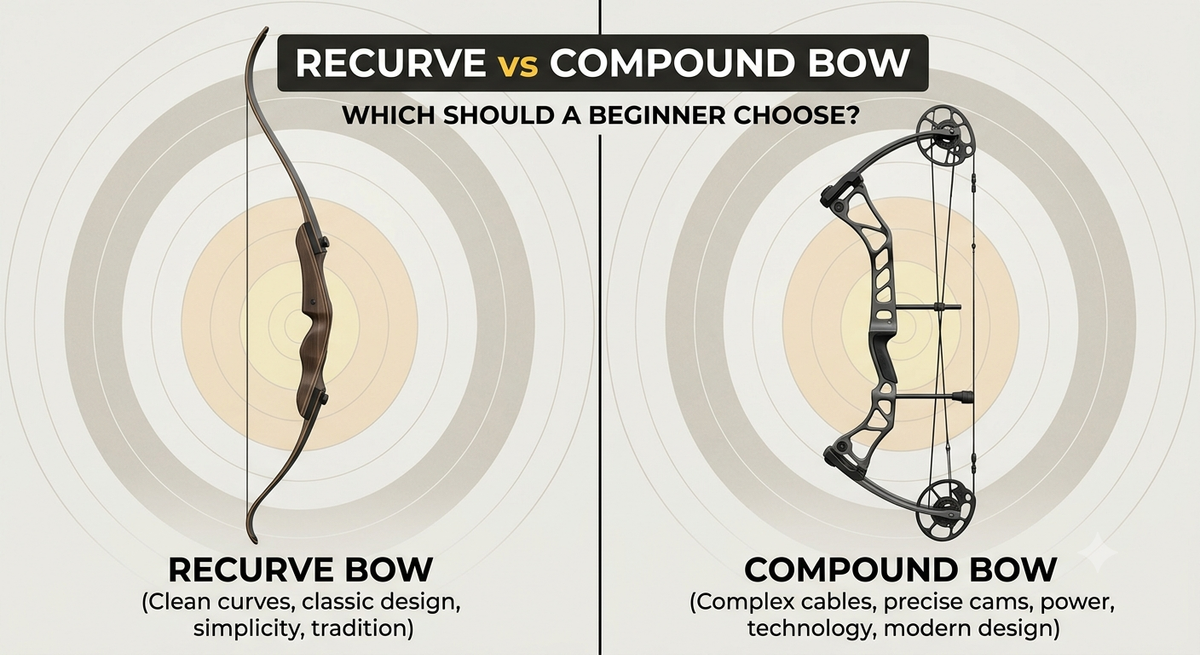
If you're picking up archery for the first time, the very first decision you'll face isn't about your stance or your grip — it's about which bow to buy. And the two names you'll hear over and over are recurve and compound.
Both bows can shoot accurately, both can be used for target archery or hunting, and both have loyal communities behind them. But they feel completely different to shoot, they cost different amounts, and they suit different kinds of beginners. Here's how to figure out which one is right for you.
The Quick Answer
- Choose a recurve bow if you want to learn proper form, are on a tighter budget, or are interested in Olympic-style target archery.
- Choose a compound bow if you want higher accuracy sooner with less physical strain, or you're planning to hunt.
Now let's break down why.
What's the Difference?
Recurve Bow
A recurve bow is the classic, simple archery image — a curved bow with a string, no pulleys, no cables. The tips of the limbs curve away from you (hence "recurve"), which stores a bit of extra energy compared to a straight limb. It's the style used in the Olympics.
With a recurve, you hold the full draw weight the entire time you aim. If it's a 20-pound bow, you're pulling and holding 20 pounds of tension until you release.
Compound Bow
A compound bow uses a system of cams (pulleys) and cables to create "let-off." This means that once you pull the string back to full draw, the force required to hold it drops dramatically — often by 65–80%. A 50-pound compound bow might only require you to hold 15 pounds at full draw.
Compounds also typically include sights, stabilizers, and mechanical releases as standard setup, which is part of why they tend to group arrows more tightly, more quickly, even for new shooters.
Recurve vs. Compound: Side-by-Side
| Factor | Recurve | Compound |
|---|---|---|
| Learning curve | Steeper — form matters a lot | Gentler — easier to shoot accurately early |
| Physical demand | Higher, holds full draw weight | Lower, thanks to let-off |
| Cost to start | Lower ($150–$400 for a beginner setup) | Higher ($400–$900+ for a beginner setup) |
| Portability | Lighter, simpler to carry and store | Heavier, more components |
| Maintenance | Minimal | More parts to tune and maintain |
| Common use | Olympic/target archery, traditional shooting | Hunting, 3D archery, some target disciplines |
| Upgrade path | Great for building fundamentals | Great if goal is precision/hunting from day one |
Why Beginners Often Start With Recurve
Most coaches recommend recurve bows to brand-new archers, and it's not just tradition. A recurve forces you to develop real form — consistent anchor point, back tension, follow-through — because there's no mechanical help compensating for bad habits. If your form is off with a recurve, you'll see it immediately in your groupings, which actually accelerates learning in the long run.
It's also the more affordable way to test whether you enjoy the sport before investing in a more expensive setup.
Recurve is a strong choice if you:
- Want to compete in target or Olympic-style archery
- Are working with a limited starting budget
- Want to build strong fundamentals before adding equipment
- Enjoy a more traditional, minimalist shooting experience
Why Some Beginners Start With Compound
Not everyone's goal is to master traditional form — some people want to shoot accurately as soon as possible, especially if the end goal is bowhunting. Because of the let-off, compound bows are physically easier to hold at full draw, which means beginners can focus on aiming rather than fighting fatigue. Sights and stabilizers are also usually built in, which shortens the accuracy learning curve.
Compound is a strong choice if you:
- Plan to hunt or want a bow capable of higher draw weights
- Have any physical limitations that make holding a full draw weight difficult
- Want faster early accuracy, even if the equipment is more complex
- Are shooting mainly for target practice, not competition rules
A Note on Cost
Budget is often the deciding factor for beginners, so it's worth being specific:
- A beginner recurve setup (bow, arrows, basic accessories) typically runs $150–$400.
- A beginner compound setup typically runs $400–$900+, mostly due to the cams, sights, and release aid.
If you're not sure archery is going to be a long-term hobby, starting with a recurve is the lower-risk way to find out.
Can You Switch Later?
Yes — and many archers do. It's common to start on a recurve to build fundamentals, then move to a compound later for hunting or if you want the mechanical advantage. The reverse also happens: some compound shooters pick up a recurve later because they enjoy the more traditional challenge. Neither choice locks you in permanently.
Bottom Line
There's no universally "better" bow — only a better bow for your goals. If you're unsure, ask yourself one question: Am I more interested in mastering technique, or in hitting the target accurately as soon as possible?
- Technique-first, budget-conscious, or target/Olympic curious → Recurve
- Accuracy-first, hunting-focused, or want less physical strain → Compound
Whichever you choose, the best next step is the same: get to a local range or club and try both in person before you buy. Most ranges rent both types by the hour, and shooting a few arrows with each will tell you more than any comparison chart can.