Korean Traditional Archery: A Beginner's Introduction

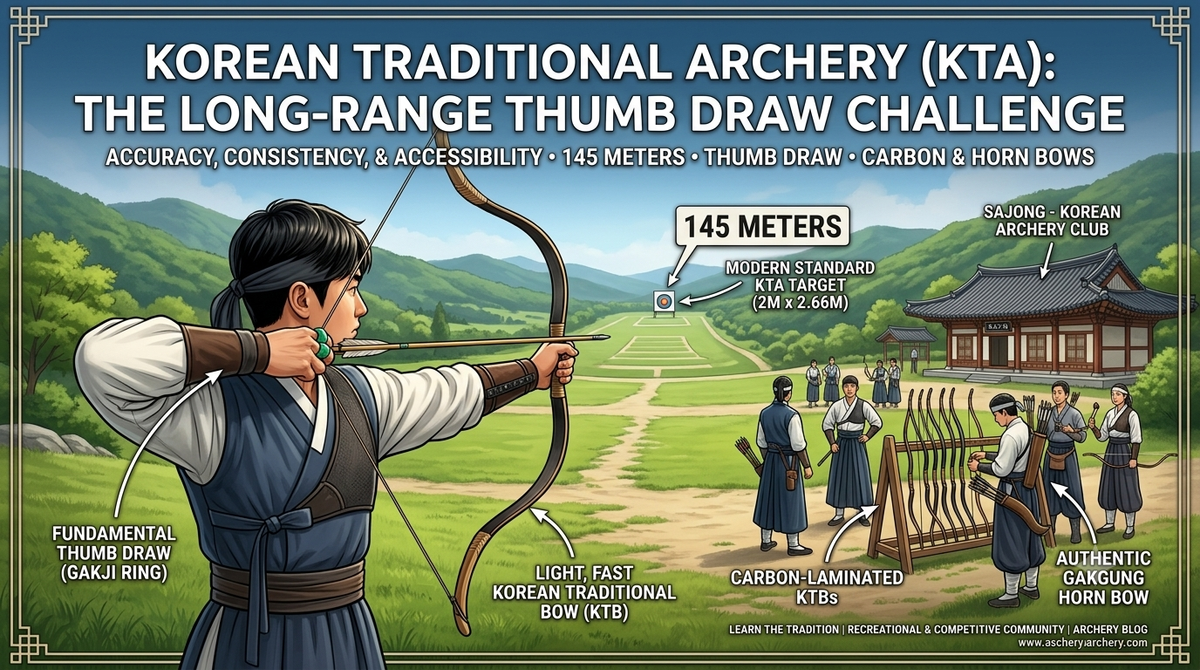
This piece comes from Hyun Goo (KTB_Bilbo), a 1 dan Korean Traditional Archery (KTA) archer who has competed and placed in local matches. If you're only familiar with Olympic recurve or compound archery, KTA is a genuinely different world, worth knowing about even if you never pick up a Korean bow yourself.
Most archery content in the English-speaking world covers Olympic recurve or compound styles almost exclusively. But roughly half the globe has historically practiced some form of thumb draw archery, a fundamentally different way of drawing a bow than the two- or three-finger draw most Western archers learn. Korean Traditional Archery, or KTA, is one of the major thumb draw traditions still actively practiced today, alongside Mongolian, Manchu, Chinese, and Japanese styles.
Thumb Draw Archery Isn't One Thing
Here's the first surprise for most newcomers: thumb draw styles across cultures aren't interchangeable, even though they share the basic mechanic of drawing with the thumb rather than the fingers. Each culture developed distinct principles, equipment, and philosophies around it:
- Manchu archery emphasizes high penetrating power, with hardware built to send heavy arrows at high speed.
- Japanese Kyudo is best understood as a martial art first and a sport second, with a strong emphasis on spiritual discipline, correct form is treated as paramount, almost choreographic.
- Chinese Gao Ying style centers on shooting heavy draw-weight bows, and has more English-language resources available than most other thumb draw traditions.
- Modern Mongolian archery involves knocking over targets with heavy arrows from roughly 70 meters away.
- Korean Traditional Archery focuses on accuracy and consistency at long range, making every arrow count, rather than raw power or ceremony.
If you're drawn to thumb draw archery generally, picking which specific tradition to follow first matters, since the techniques and equipment often don't transfer cleanly between them.
A Long History in Korea
Archery held a uniquely high status in Korean society for centuries. It wasn't a niche pursuit, it was expected of the upper class and practiced widely by common people too:
- Nobility and the royal family were expected to practice archery as a matter of course.
- Military officer qualification exams, and even regular exams for active-duty soldiers, always weighted archery heavily.
- Government officials took regular archery tests, and many ceremonial events incorporated it.
- High scorers could be rewarded with promotions or prizes.
Archery ranges existed in essentially every region of Korea, functioning as local community hubs where civilians shot recreationally and military candidates trained side by side, usually led by retired officers with active-duty coaches running the training.
What Modern KTA Actually Looks Like
Historically, the most common form of competitive and military archery was willow-leaf arrow, shooting a 2m x 1.38m target with a 30g arrow from 145 meters away. Modern KTA is its direct descendant, today's standard is a 2m x 2.66m target shot from the same 145-meter distance, and this single format is what over 90% of Korean Traditional archers practice and compete in.
The scale of the modern community might surprise people outside Korea: there are roughly 400 archery ranges across the country, with around 30,000 archers actively competing (and more who shoot without competing). Matches and rank qualification tests run most weekends in every region, and an archer's skill level is tracked through a dan ranking system, similar in spirit to rank systems in other traditional Korean and East Asian disciplines.
There's No Single "Correct" Form
This is one of the more counter-intuitive things about KTA for newcomers: there has never been one standardized form. Every region and often every individual archer historically shot somewhat differently. One of the most highly regarded historical Korean archery manuals, explicitly states it only records the form practiced in the Seoul region at the time it was written, not a universal standard.
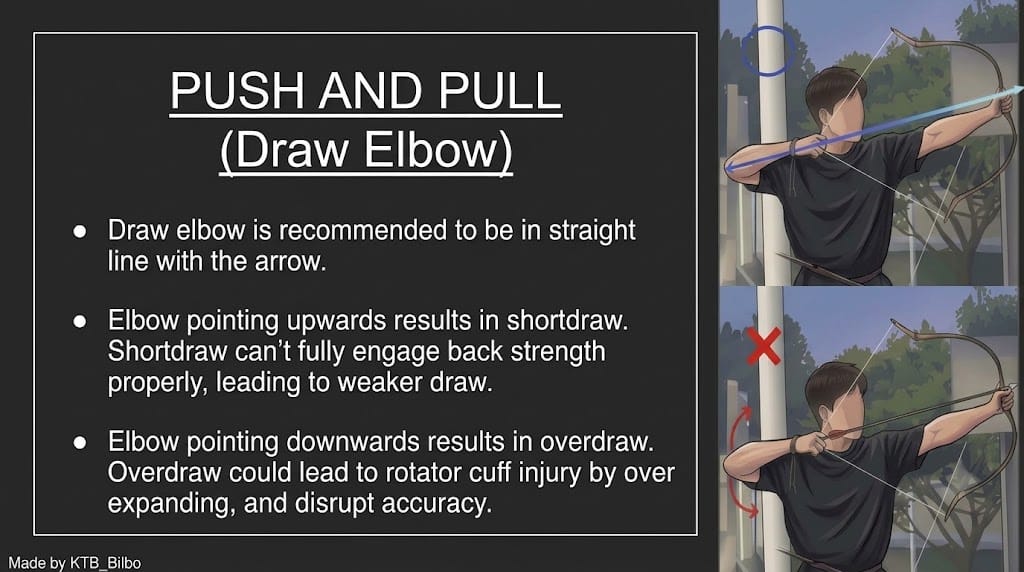
Because of this, KTA manuals have traditionally focused on teaching foundational principles rather than prescribing one fixed form, and instruction has relied heavily on coaches passing down technique based on their own experience and regional tradition. Ultimately, what determined a good archer historically wasn't how closely their form matched a manual, it was their score.
The Equipment: Korean Traditional Bows (KTB)
Korean Traditional Bows are light, fast-shooting bows built for long-distance accuracy rather than raw power:
- They can shoot very light arrows efficiently, suited for the long-distance target format KTA uses.
- Pricing tends to be accessible, particularly for bows bought from Korea-based makers, since many brands have pricing effectively fixed by the Korean National Archery Association.
- Because nearly every serious Korean archer competes using these bows, the performance bar for commercial models is high, a bow that performs noticeably poorly simply doesn't survive in the market.
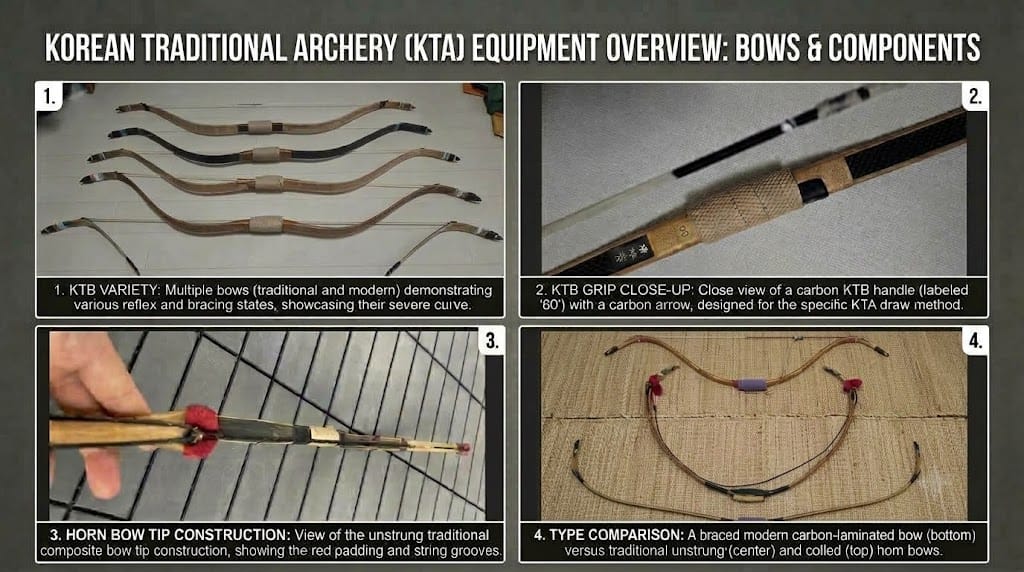
There are two main types: natural horn bows and modern carbon-laminated bows. Horn bows are historically authentic but extremely delicate to maintain, generally not recommended unless you have access to an experienced horn bow specialist in person. Carbon-laminated bows are the practical choice for the vast majority of archers, over 70% of competitive KTA archers shoot them, and even within Korea, only archers ranked 5th dan and above are typically expected to shoot horn bows at all.
If You Want to Learn More
Because most historical KTA manuals were written in classical Korean, they're genuinely difficult to translate well, even into modern Korean, let alone English. As a result, most beginner instruction in Korea happens through coaches teaching their own style in person rather than through manuals directly.
About the author
Hyun Goo (KTB_Bilbo) is a 1 dan Korean Traditional Archery archer who has competed and placed in local matches. He shares beginner-friendly guides and instructional content on Korean Traditional Archery.
- Instagram: @ktb_Bilbo
- YouTube: @KTB_Bilbo