10 Common Beginner Archery Mistakes and How to Fix Them

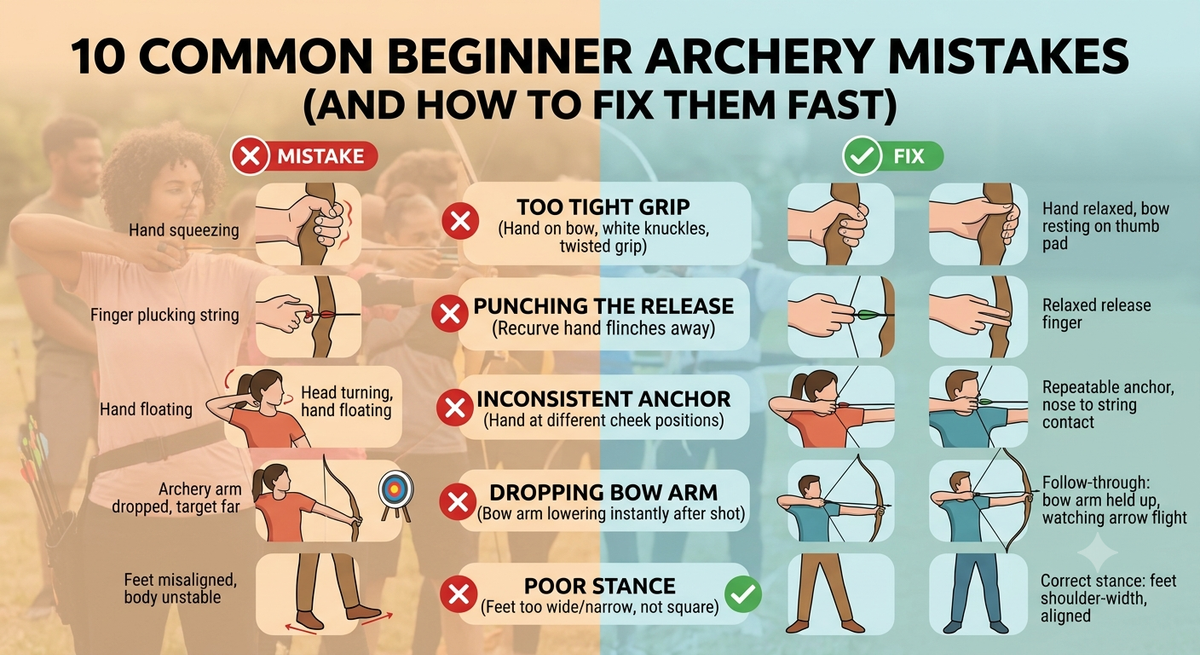
If your arrows are scattering more than grouping, you're not doing anything wrong that every archer hasn't done before. Almost every beginner mistake in this sport traces back to a small handful of habits — and most of them are easy to fix once you know what to look for.
This list pairs each mistake with a quick fix you can try on your very next range session.
(New here? Start with our guides to stance and form, choosing between recurve and compound, and beginner gear — several of these mistakes connect directly back to those basics.)
1. Gripping the Bow Too Tightly
The problem: A tense, white-knuckle grip on the bow twists it slightly at the moment of release, sending the arrow off-line.
The fix: Let the bow rest in the pad at the base of your thumb rather than squeezing it in your palm. Your hand should stay relaxed enough that you could almost let the bow fall forward after the shot (many advanced archers do exactly this, using a wrist sling to catch it).
2. Punching the Trigger or Plucking the String
The problem: Anticipating the shot and snapping the release (compound) or yanking your fingers away (recurve) instead of letting it happen naturally. This is one of the single biggest causes of inconsistent groupings.
The fix: Focus on relaxing into the release rather than triggering it. For recurve, practice simply relaxing your string fingers rather than opening your hand. For compound, use back tension to activate the release so it comes as a small surprise rather than a deliberate press.
3. Inconsistent Anchor Point
The problem: If your string hand lands in a slightly different spot on your face every shot, your aim point changes every shot too, even if everything else is correct.
The fix: Pick one specific anchor point (corner of mouth, under chin, etc.) and drill it obsessively until it's automatic. Some archers use a kisser button or consistent chin contact as an extra reference point.
4. Collapsing at Full Draw
The problem: Letting your draw arm or shoulder creep forward slightly right before or during the release, which throws off your aim and power.
The fix: Focus on continuing to pull with your back muscles all the way through the shot, rather than "holding" with just your arm. This is closely tied to follow-through — if you're collapsing, you're probably also dropping your bow arm too early.
5. Dropping the Bow Arm Too Early
The problem: Lowering your bow arm the instant the arrow leaves (or even slightly before), which can nudge the arrow off-target during its critical first moments of flight.
The fix: Hold your full-draw position for a full one to two seconds after release. If you can watch the arrow hit the target while your bow arm is still up, you're following through correctly.
6. Mismatched Arrow Spine or Length
The problem: Arrows that are too stiff, too weak, or the wrong length for your draw length and bow weight will fly inconsistently no matter how good your form is. This is a gear problem masquerading as a form problem.
The fix: Have your arrows matched to your specific bow and draw length by someone at an archery shop, not picked based on price or generic online recommendations. This is one of the few mistakes that no amount of practice will fix.
7. Improper Stance Width or Alignment
The problem: A stance that's too wide, too narrow, or not properly aligned with the target creates instability that shows up as left-right inconsistency in your shots.
The fix: Start with a simple square stance, feet shoulder-width apart, both feet parallel to an imaginary line running to the target. Get this checked by someone experienced before adjusting it further.
8. Torquing the Bow
The problem: Twisting the bow slightly (often from gripping too hard, per mistake #1) changes the angle of the arrow at release in ways that are hard to feel but easy to see in your groupings.
The fix: Relaxed grip, first and foremost. If it persists, ask a coach to check whether your hand position on the grip is consistent shot to shot.
9. Rushing the Shot
The problem: Especially common in beginners eager to see where the arrow lands, rushing skips over the aiming and settling phase, which increases inconsistency in every step that follows.
The fix: Build in a deliberate pause at full draw before you aim and release. Some archers count silently ("one, two, three") at full draw until slowing down becomes natural.
10. Practicing Volume Instead of Quality
The problem: Shooting 100 arrows with the same flaw baked into every one just reinforces the mistake 100 times. More shooting isn't automatically better practice.
The fix: Shoot in shorter sets (3 to 6 arrows) and focus on one specific element of your form per session. Record yourself on video occasionally, or ask an experienced archer to watch a handful of shots. A short correction early is worth more than weeks of unsupervised repetition.
The Pattern Behind Most of These
Notice that most of these mistakes trace back to just two root causes: tension (gripping, punching, rushing) and inconsistency (anchor point, stance, follow-through). If you're not sure which mistake is affecting you, start by checking whether you're tense anywhere you don't need to be, and whether you're doing the exact same thing on every single shot.
Fixing form is rarely about trying harder — it's usually about relaxing more, and repeating the same sequence on purpose every time.
Coach, club owner, or archer with a story to tell? This could be your post.