Printable Archery Training Log
Use this free printable archery training log to keep an archery practice diary on paper. Record distance, arrows shot, score, and average per arrow, plus conditions and feel, then download an A4 or Letter PDF — no account required. Share the layout with a coach via the URL, or scan the footer QR to log the same session in ScoreMyArrow.
Sheet options
Number of rows
Preview
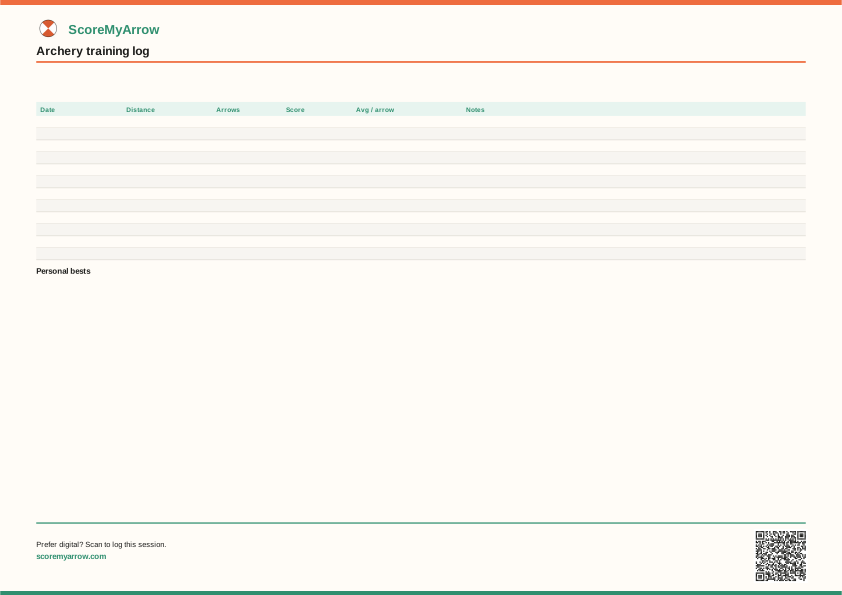
How to use an archery training log to improve
An archery training log is a practice diary, not a scorecard for a judge. You fill it after (or during) a session so you can track archery progress across weeks instead of trusting memory. Start every row with the facts that let you compare later: date, distance, face size if it changed, arrows shot, and total score. Leave the average column blank on the sheet and fill it when you get home. Archery average score per arrow is total score divided by arrows that scored — 270 from 36 arrows is 7.5. One-off scores lie. A 330 at 18 metres does not tell you whether 70 metres is improving. Averages at the same distance and face do.
Write conditions in a few words: indoor, outdoor, wind, rain, cold hands. Feel is five empty circles so you can mark how the session sat without writing an essay. Notes hold the drill, a setup change, or the sentence you will not remember in a month. If you swapped a plunger or a new serving, tick Equipment or setup change so a later slump is not a mystery.
Use Layout → Per session for club nights where one line per evening is enough. Switch to Per end when you want an archery session log that shows which end dropped. Set arrows per end from 3 to 6; each row becomes one end with a box per arrow. That is how you see fatigue in ends 8–12 without pulling out a separate scorecard.
Review once a week, not after every arrow. Look for three patterns. Drift: averages sliding down at one distance while others hold. Fatigue: early ends fine, late ends messy, or Tuesday night worse than Saturday. Equipment: a step change on the date you altered brace height or spine. Personal bests on the last page are four lines — distance, score, date — so a 50 m outdoor best is not mixed with an indoor Portsmouth. What’s working and What to fix next session close the loop: pick one fix, shoot it next time, write whether it helped.
Print landscape A4 by default so twenty session rows fit one page. Forty rows paginate with the same table headers and a page number. Share the URL with a coach if you want them to print the same columns. The footer QR opens the ScoreMyArrow training log if you would rather type the same archery practice diary on your phone. This PDF does not give medical advice; it is a record of practice so you can see the work.
FAQ
- What should I write in an archery training log?
- Distance, arrows, score, average per arrow, conditions, feel, plus notes on setup or the drill. Leave average blank on the sheet and fill it after you add the arrows.
- How often should I log my practice?
- Every session you care about later. A short club night still belongs in the log if you want trends; skip idle warm-up-only days if they would drown the useful rows.
- How do I calculate my average score per arrow?
- Total score divided by arrows shot (count only arrows that scored). Example: 270 from 36 arrows is 7.5 per arrow. Compare averages at the same distance and face, not a 70 m outdoor score against an 18 m indoor one.
- Can I log ends instead of whole sessions?
- Yes. Switch Layout to Per end and set arrows per end (3–6). Each row is one end with arrow boxes, so you can see which end dropped without a separate scorecard.
- Is there an app for tracking archery scores?
- Yes. ScoreMyArrow has an authenticated Training log for session notes, personal bests, and analytics. This PDF is the paper version; the footer QR opens the in-app log. The generator itself does not require sign-up.
Related
- Scorecard generator
- Target plotting sheet
- Sight mark chart
- Calculators
- How to review an archery training log (blog, coming soon)
- What average per arrow tells you (blog, coming soon)